As I write this, pretty much the entire country stares down the muzzle of a polar vortex. If you’re like me, you’re asking yourself “will my loquat freeze tonight?”
The understanding that I’ve had for years has been that the loquat tree itself is very cold tolerant. When winter storm Uri hit in 2021, it hit the low temperature of 6 degrees Fahrenheit, a temperature which Austin sees only every fifty years or so (although global warming might be changing that, so fingers crossed!). Even with this extremely low temperature, the ostensibly tropical loquat trees largely survived. You can see some damaged trees to this day (prune your dead limbs, loquat owners!), but by and large the trees themselves pulled through.
I also had the understanding that while the fruit has a modest amount of freeze tolerance, the flowers have only a small ability to withstand freeze. For this reason we lose the loquat crop every third year. But what are the actual numbers on this, and what have we seen in the past? To answer these questions, I correlated Austin’s historical freeze records and my last 13 years of loquat harvest records.
In the following harvest summaries, I’ve defined a good year as one where nearly every loquat tree was loaded with fruit, a mediocre year has some fruit available but you have to hunt for trees which have survivors, and a bad year has few to no surviving fruit. Whether it’s the local micro-climate or genetic variation between the plants, we’ve been noticing that some trees have more survivors on bad years than others (but we will not tell you which ones those are, sorry).
For each month of winter, I have the date and temperature of the coldest night.
2012 – GOOD LOQUAT YEAR Dec7-22°, Jan14-22°, Feb12-29°, enough loquats to make pie
2013 – GOOD LOQUAT YEAR, Dec30-21°, Jan6-25°, Feb16-28°, March1-26°, harvested loquats at our friend John’s house
2014 BAD LOQUAT YEAR Dec 16-25°, Jan7-12°, Feb27-25°, no records of any harvest
2015 – GOOD LOQUAT YEAR, Nov19-26°, Dec29-25°, Jan8-21°, Feb-25°, made pie and jam
2016 – GOOD LOQUAT YEAR, Nov23-27°, Dec19-28°, Jan23-25°, Feb5-23°, made a batch of wine
2017 – MEDIOCRE LOQUAT YEAR, Dec19-24°, Jan8-16°, we found enough loquats to make jam
2018 –MEDIOCRE LOQUAT YEAR, Dec13-27°,Jan3 – 15°, Jan17-15°, Feb11-29°, discovered only four surviving fruit
2019 GOOD LOQUAT YEAR, Nov14-24°, Dec16-28°, Jan24 – 25°, Feb13-27°,March6-24°, made a batch of chutney
2020 – GOOD LOQUAT YEAR, Dec19-20°, Jan8-24°, Feb27-24°, made chutney, candy, and wine
2021 – BAD LOQUAT YEAR, Feb16 – 6°, Uri. No survivors
2022 – BAD LOQUAT YEAR, Dec12-26°, Jan3 – 21°, Jan22-19°, Feb6 – 18°, March13-19°, no records of harvest
2023 – BAD LOQUAT YEAR, Dec23-14°, Jan14 – 25°, Feb17 -24°, no records of a harvest
2024 – MEDIOCRE LOQUAT YEAR, Jan13 – 21°, Jan17 – 11°, found enough loquats to make icecream and throw an invite-only Loquat Fest
2025 – BAD LOQUAT YEAR, Dec12-26°, Jan21-22 – 16°, Feb20 – 19°, a mere handful of loquats found despite a wide search of the city
2026 – MEDIOCRE LOQUAT YEAR, Jan27 – 17°, Several trees had low loads of fruit, enough for a Loquat Fest. Borderline bad year.
Results of the Loquat Frost Tolerance Study
Looking at the numbers, the first thing that jumps out is the terrible string of bad winters since the formation of Loquat Fest. Is Loquat Fest itself a curse on the Austin loquat harvest? We can only hope that’s pure superstition.
Here’s some generalized conclusions:
- We can expect a good harvest roughly 50% of the time
- We can expect to find essentially nothing 25% of the time
- If the freezes stay in the twenties all winter, then we’ll have a blockbuster loquat harvest
- If the freezes get into the teens, then the harvest will suffer
- If the sub-20s freezes happen in late January or later, then the results will be better, but still not great
The spanner in this whole discussion is the comparison between 2024 and 2025. The winter of 2024 was demonstrably colder than 2025, yet it had a much better (although admittedly poor) loquat harvest. Let’s just stick a pin in that question for now, once this weekend shakes out we may have more insight into that discrepancy.
How Can I Tell if the Freeze Killed My Fruit?
It’s really tricky to ascertain the damage caused by a frost before at least a month has passed. In 2026 I scouted out a number of trees after a seventeen degree night, and thought that a lot of fruit had survived. There were little nubbins which were green and apparently growing even weeks afterward. There were even fresh flowers blooming. And then they just died.
In 2026 the harsh freeze caused visible damage to even those few loquat fruit which survived. They were blotchy and under-sized, and I would like to say that the skins were tougher than usual.
How Do I Protect My Loquats from Freeze?
Loquat trees very quickly become too large to completely cover, and certainly too large to put in a pot which you can take inside. But it doesn’t take much to make the difference between a crop that survives and one which does not, the difference is just a few degrees. Planting the trees in protected areas around buildings or fences may help (this is an avenue of ongoing study, so email us if you noticed anything interesting). It may help to plant trees descended from variants with a known propensity to survive cold (this is an ongoing plant husbandry goal of Loquat Fest).
This weekend I’m experimenting with partial wrapping of trees. Since it’s hard to wrap an entire tree, I merely wrapped a couple of limbs so I wouldn’t have to suffer through a year without loquats in a worse case winter scenario. The partial wrapping failed, nothing survived! But luckily some unwrapped trees produced fruit.
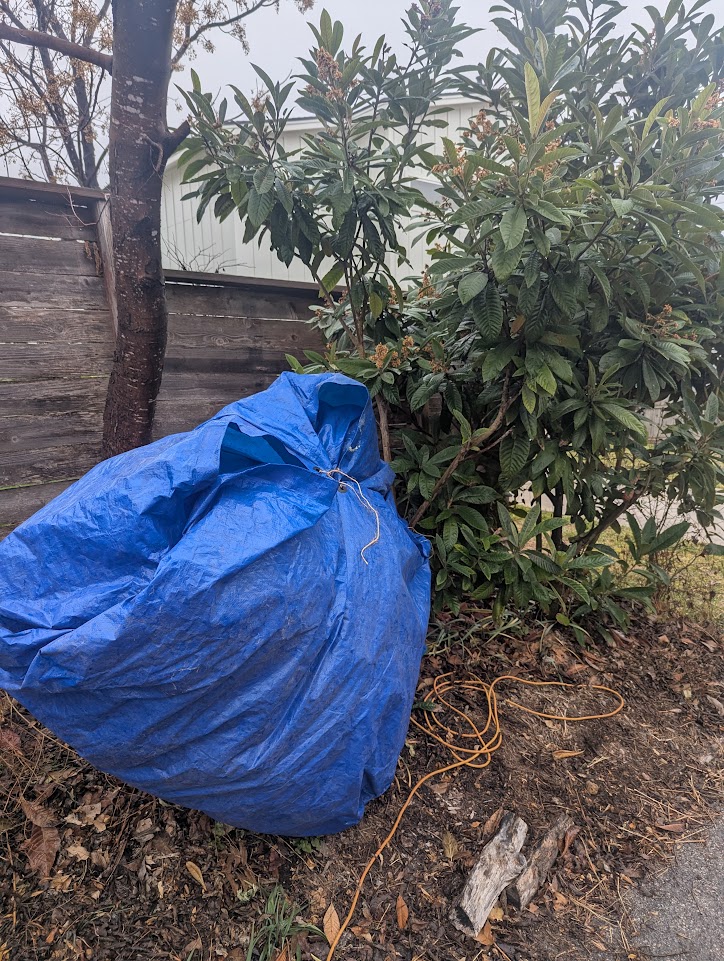
A few things to keep in mind when covering plants in Texas. A single layer of plastic tarp probably won’t do you any good, since it has terrible heat retention properties. You will want to use two layers of tarp, or use some other material which comes in giant sheets, is waterproof, is thick enough to hold in heat, and is affordable. Canvas may fit this bill, but I’ve never seen it for sale, whereas giant plastic tarps are super-cheap at Harbor Freight. Also, make sure your edges are sealed the same way you would seal the openings of a parka before going outside in Minnesota. If the wind levers open a gap in your covering along the ground, it will whisk out all your heat and scorch and frost-sensitive plants inside. What I’ll do is weigh the edges of the tarp down with a continuous line of firewood logs. And thirdly, an electric heat source is great, but the more effective they are the more dangerous they are once you put them outside in a bunch of dry plants during a windstorm. In the above photo I’m using a seedling heating mat (it’s inside the tarp so you actually can’t see it), which is reasonably waterproof and doesn’t get scorching hot, just pretty warm.
So hang in there! We’ll have good loquat harvests again, just give it time.